
CYPRUS · COMPANY FORMATION & FIDUCIARY
Cyprus IP Box Regime & IP Licensing: Nexus Approach & Tax Structuring
Establishing an intellectual property (IP) holding structure in Cyprus enables global innovators, software developers, and technology enterprises to secure competitive fiscal efficiency within the European Union. CX Financia provides end-to-end Cyprus IP Box Regime & IP Licensing advisory, guiding technology firms, biotech ventures, and international licensors through the statutory application of the OECD-compliant Modified Nexus Approach. Directed by Xenia Neophytou, FCCA, our team structures, registers, and defends corporate IP assets to achieve an effective 3.0% corporate tax rate
on qualifying IP profits while ensuring full compliance with local tax legislation and international transfer pricing standards.
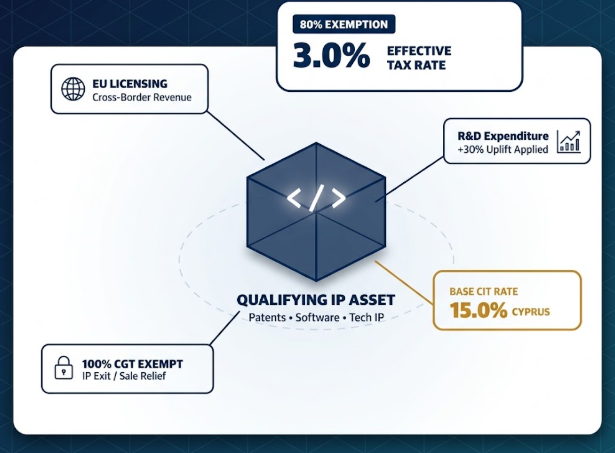
Cyprus IP Box Regime & IP Licensing Overview
Under the Cyprus IP Box Regime (Section 8(22) of the Income Tax Law), qualifying profits derived from qualifying intangible assets benefit from an 80% tax exemption. Applied to Cyprus’s 15% corporate tax rate, this results in an effective corporate tax rate as low as 3.0% on net qualifying IP income.
To secure and maintain these fiscal benefits under OECD Action 5 mandates, the IP holding entity must demonstrate a direct economic link—the “Nexus”—between the research and development (R&D) expenditure incurred locally and the income generated by the resulting intangible asset.
Our practice delivers operational execution and tax advisory across the full lifecycle of your intellectual property assets:
- Qualifying Asset Verification: Evaluating software codebases, patents, utility models, and copyrighted IP assets to confirm eligibility under Cyprus Tax Department guidelines.
- Nexus Ratio Calculation & R&D Tracking: Establishing operational expenditure tracking systems to maximize qualifying R&D expense ratios (including the statutory 30% uplift allowance).
- Cross-Border Licensing & Royalty Structuring: Drafting intra-group IP licensing agreements, establishing arm’s-length royalty rates, and ensuring transfer pricing defense documentation.
- IP Protection & Registration: Coordinating trademark, patent, and industrial design filings across the Cyprus Intellectual Property Section, EUIPO, and WIPO.
Cross-Border Architectural Note:
For broader multi-jurisdictional holding structures or parent entity integration, visit our
Corporate Services in Cyprus hub and International Business Structuring page. For routine bookkeeping, quarterly VAT returns on licensing, and annual tax filings (TD4), refer to our Tax & Accounting Services in Cyprus practice.
WHAT WE DELIVER
Core IP Box & Licensing Services
Modular advisory engagements tailored for tech startups, SaaS providers, software scale-ups, and corporate IP licensors:
1. IP Asset Eligibility Assessment & Tax Modeling
- Analyzing IP assets to verify eligibility (patents, copyrighted software, utility models) while excluding non-qualifying marketing-related IP (trademarks, brand names, domain names).
- Modeling projected royalty income, licensing fees, and capital gains tax positions under the Modified Nexus Approach.
2. R&D Expenditure Tracking & Nexus Optimization
- Structuring accounting workflows to segregate Qualifying R&D Expenditures (direct R&D, outsourced R&D to non-related parties) from Non-Qualifying Costs (acquisition costs, group-outsourced R&D).
- Applying the 30% Uplift Allowance on qualifying expenditure to offset non-qualifying R&D costs and maximize the 80% tax deduction.
3. IP Licensing Agreements & Transfer Pricing Defense
- Drafting cross-border IP licensing, white-labeling, and software-as-a-service (SaaS) agreements aligned with international arm’s-length principles.
- Preparing local transfer pricing Master Files and Local Files in accordance with Cyprus Transfer Pricing rules and OECD guidelines.
4. Capital Gains Tax Exemption on IP Disposal
- Structuring the direct sale or disposal of qualifying intangible assets to benefit from a complete 100% exemption from capital gains tax in Cyprus.
- Managing corporate redomiciliation or asset transfers to safeguard historical IP development value without triggering exit tax friction.
ONGOING STATUTORY OBLIGATIONS
Regulatory Framework & Statutory Compliance Checklist
Maintaining the 3.0% effective IP tax rate requires ongoing alignment with the Cyprus Tax Department, EU directives, and OECD standards.
| Asset Classification | Included Assets | Tax Treatment |
| Qualifying Assets | Patents, utility models, copyrighted computer software, legally protected IP | 80% Deduction on Net Income (3.0% Effective Rate) |
| Non-Qualifying Assets | Trademarks, trade names, brand assets, domain names, image rights | Standard Corporate Tax Rate applies (15%) |
Included in Your IP Box & Licensing Engagement
- R&D Expense Ledger & CIGA Tracking:
Maintaining granular accounting records detailing direct R&D costs, third-party contractor invoices, and local technical substance to satisfy OECD Core Income Generating Activities (CIGA) requirements. - Transfer Pricing Local File Preparation:
Compiling transfer pricing documentation for all intra-group licensing arrangements exceeding €750,000 annually per asset category. - Form TD4 Statutory Income Tax Filing:
Correctly reporting the IP Box deduction calculation on the annual corporate tax return via the Tax For All (TFA) portal, backed by audited IFRS financial statements - EU Withholding Tax Alignment:
Leveraging the EU Interest and Royalties Directive to eliminate withholding tax on incoming and outgoing royalty payments across European subsidiaries.
WHY SUBSTANCE MATTERS
Jurisdiction Comparison: European IP Regimes
When evaluating operational hubs for software development and IP management, Cyprus offers significant tax efficiency, zero stamp duty on intra-group transfers, lower operational costs, and flexible Nexus tracking compared to traditional financial centers.
| Metric / Parameter | Cyprus (IP Box) | Netherlands (Innovation Box) | Luxembourg (IP Regime) | Ireland (Knowledge Dev Box) |
|---|---|---|---|---|
Headline Corporate Tax | 15.0% | 19% – 25.8% | 24.94% | 12.5% / 25% |
| Effective IP Income Tax Rate | 3.0% | 9.0% | ~5.2% | 6.25% |
Qualifying Assets Include Software? | Yes (Copyrighted Software) | Yes (Subject to R&D Certificate) | Yes (Patents & Software) | Yes (Computer Programs) |
Capital Gains Exemption on IP Sale | 100% Exempt | Partial Exemption | 80% Exempt | Subject to Standard Relief |
| Dividend Withholding Tax (Non-Residents) | 0% | 15% | 15% | 25% (Unless Exempt) |
| Substance & Development Costs | Low to Moderate | High | Very High | High |
HOW ONBOARDING WORKS
Step-by-Step Onboarding Process & Operational Flow
1
IP Asset Audit & Eligibility Analysis
Weeks 1–2)
Evaluating software code, patents, or utility models, establishing asset qualification under Section 8(22), and forecasting effective tax savings.
2
Entity Formation & R&D Setup
Weeks 2–4
Incorporating the Cyprus holding/operating company, establishing resident board substance, and configuring IFRS accounting software to segregate R&D expenses.
3
Licensing Agreements & Transfer Pricing
Weeks 4–6
Drafting intra-group IP licensing contracts, setting arm’s-length royalty fees, and preparing transfer pricing defense documentation.
4
IP Registration & Revenue Activation
Weeks 6–8
Filing national or European IP protection applications and routing licensing revenues through the Cyprus entity.
5
Annual Tax Filing & Nexus Defense
Retained
Managing ongoing Nexus ratio calculations, preparing audited financial statements, and filing annual Form TD4 tax returns claiming the 80% deduction.
CLIENT SUCCESS STORY
Scaling an EU SaaS Platform Under the 3.0% Tax Rate
“CX Financia structured our software IP holding model when we expanded across the EU. They audited our codebase eligibility, established an arm’s-length intra-group licensing framework, and implemented the Nexus expenditure tracking. We secured full EU regulatory compliance while maintaining an effective tax rate of 3.0% on worldwide software subscriptions.”
— Chief Technology Officer, Enterprise SaaS Group

- 3.0% Effective Tax Rateachieved on global software-as-a-service licensing revenue.
- 100% Tax Exemption
secured on qualifying software IP capital valuation growth. - CIT Full Transfer Pricing Compliance
established across 4 operational EU subsidiaries.

ICPAC
ACCA
CySEC
ANSWERS
Frequently asked questions
FAQ JSON-LD schema: included via the Custom HTML block below — keep it in sync with these questions
Does proprietary software qualify for the Cyprus IP Box Regime?
Yes. Computer software protected by copyright automatically qualifies as an eligible intangible asset under the Cyprus IP Box Regime. To claim the 80% tax deduction, the software code must be developed directly by the Cyprus entity or through non-related third-party R&D subcontractors.
How is the Nexus Ratio calculated under the Modified Nexus Approach?
The Nexus Ratio determines the proportion of net IP income eligible for the 80% tax exemption. Cyprus strictly adheres to the OECD Modified Nexus Approach https://www.oecd.org/en/topics/base-erosion-and-profit-shifting-beps.html (specifically BEPS Action 5), which requires a direct link between R&D expenditure and the resulting IP income.
The Nexus Ratio is calculated by dividing the sum of Qualifying Expenditures and Uplift Expenditures by the Total Expenditure.Where Qualifying Expenditures include direct R&D costs and non-related party outsourcing, Uplift Expenditures equal the lesser of 30% of qualifying expenditures or actual acquisition/related-party costs, and Total Expenditures represent all costs incurred to develop the IP asset.
Can trademarks and brand names benefit from the 3.0% IP Box tax rate?
No. Under OECD Action 5 standards implemented in Cyprus tax law, marketing-related intellectual property, such as trademarks, trade names, brand assets, and domain names, are explicitly excluded from the IP Box regime. Income derived from these assets is taxed at the standard Cyprus corporate tax rate of 15%.
What happens if R&D is outsourced to a related group company?
Outsourcing R&D to a related group entity is treated as a non-qualifying expenditure in the primary Nexus ratio calculation. This guidance is detailed in the official circulars issued by the Cyprus Tax Department regarding the application of the IP Box provisions. However, the regime allows a 30% uplift on direct qualifying expenses, which can partially offset related-party outsourcing costs to preserve a high effective tax exemption.
⚙ Custom HTML block below — FAQ JSON-LD schema (invisible on the live site). Keep it in sync if you edit the FAQs.
Ready to Optimize Your Intellectual Property Tax Strategy?
Speak directly with our senior IP tax specialists to evaluate your software or patent eligibility, model your Nexus ratio, and structure a compliant Cyprus IP vehicle.
Our team delivers end-to-end Cyprus IP Box Regime & IP Licensing advisory built to protect your innovations, streamline international licensing, and minimize global tax exposure.